


Walk past a school at seven in the morning and you will most likely see a rush of activity — children arriving, bags being dropped, the day beginning in something close to organised chaos. What you will rarely see is stillness. And yet stillness, as it turns out, is one of the most productive things a student can practise.
Yoga is not new to Indian education. It has roots in the Gurukul tradition, where the development of the body, mind and character were considered inseparable from academic learning. What has changed in recent years is the growing body of evidence that yoga in school — practised regularly and taught properly — makes a measurable difference to how students cope, concentrate and perform.
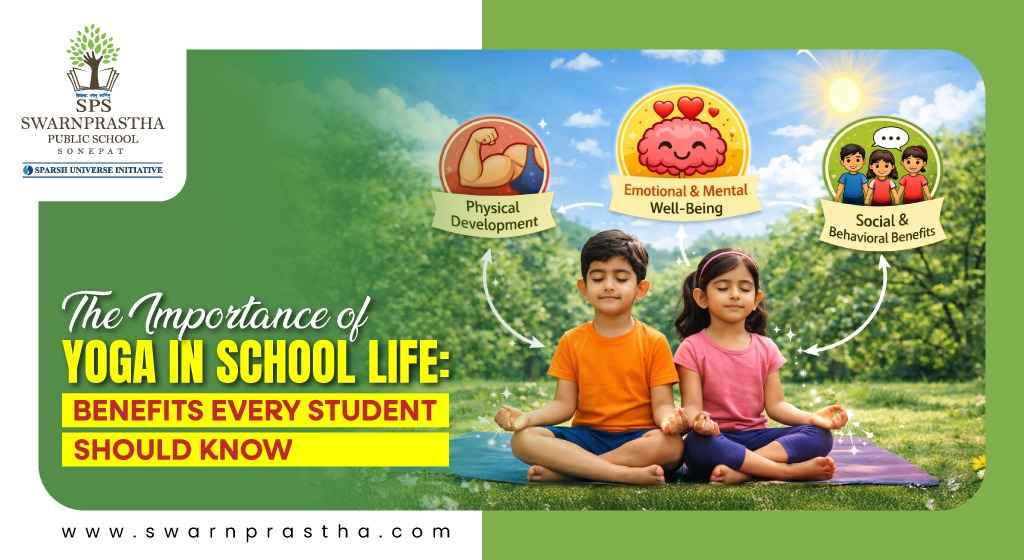
At SPS, Yoga, Pranayama and Meditation are part of the school’s co-curricular programme, not as extras bolted on to the timetable, but as practices that are woven into daily school life. Here is why that matters — and what it means for your child.
Yoga and the Pressure of the School Day
Most parents are aware that school life today is more pressured than it was a generation ago. Examinations begin earlier. Competition for marks starts from the junior classes. By the time students reach Class IX or X, the academic load is substantial — and many of them carry it without any tool for managing stress.
Yoga addresses this directly. Breathing exercises — Pranayama — teach students to regulate their nervous system. A child who has practised controlled breathing for even a few months responds differently to pressure than one who has not. The anxiety before an examination does not disappear, but it becomes manageable. That is a practical skill, not a philosophical one.
What Yoga Actually Does for Concentration
There is a common assumption that concentration is either something a child has or does not have. In practice, concentration is a capacity that can be trained. Yoga is one of the most effective ways to do that.
Holding a posture requires sustained attention. Meditation asks a student to observe their own thoughts without reacting to them. Pranayama ties the mind to the rhythm of the breath. Each of these practices builds the same underlying ability: the capacity to stay present with one thing for a sustained period.
In a classroom, that ability translates directly. A student who can settle their attention is a student who listens more carefully, reads more carefully and retains more of what they encounter. The connection between yoga practice and academic performance is not indirect. It is straightforward.
Physical Health Is Part of Academic Health
Children in a school in Sonipat spend a large part of their school day seated. By the upper classes, this can mean six to eight hours of sitting — in class, during study periods, and even at mealtimes. The physical consequences of this are well documented: poor posture, back tension, fatigue, reduced circulation. These are not trivial complaints. A child who is physically uncomfortable finds it harder to concentrate and easier to become irritable.
Yoga works against these patterns. Asanas (postures) stretch and strengthen the spine, open the chest and release tension from the shoulders and neck — the areas most affected by prolonged sitting. Students who practise regularly tend to sit better, move more freely and report less fatigue through the school day.
At SPS, the approach to physical development has always been broad. The school offers a wide range of sports including Football, Tennis, Basketball, Cricket, Badminton, Swimming, Squash, Taekwondo and Shooting. Yoga sits alongside these as a different kind of physical practice — one that builds inward awareness as much as outward fitness.
Emotional Steadiness: What Parents Often Overlook
Academic results get most of the attention in school conversations. Emotional steadiness rarely comes up — until something goes wrong. A student who struggles with frustration, who reacts badly under pressure, who finds it difficult to recover from setbacks: these are children who need emotional tools, not just academic ones.
Meditation, in particular, builds what might be called 'emotional distance' — the ability to observe a feeling rather than be consumed by it. This is not taught in most academic subjects. Yoga offers it as a natural by-product of regular practice.
Students who are emotionally steadier tend to manage peer relationships better. They handle the disappointment of a poor grade differently. They are more resilient during examinations. These outcomes matter to parents, even if they are harder to measure than marks.
How Yoga Fits Into Life at SPS
SPS draws its educational philosophy from both modern pedagogy and the Gurukul tradition. The school’s belief in holistic development — intellectual, physical, moral and spiritual — is not a statement on a page. It shapes how the school day is actually structured.
Yoga, Pranayama and Meditation are included as part of the school’s co-curricular programme because we believe that a student who is physically at ease, emotionally steady and mentally focused will achieve more — in examinations and beyond them. The practices complement the rest of what SPS offers:
• A broad sports programme that builds physical confidence and competitive spirit
• Counselling sessions that support students through academic and personal challenges
• A curriculum designed to develop critical thinking alongside subject knowledge
• A residential environment where students learn to manage themselves and their time
Yoga does not stand alone in any of this. It is one strand in a wider committment to the whole child.
A Note for Parents Whose Children Are Reluctant
Some children take to yoga immediately. Others resist it — particularly older students who see it as slow or too quiet compared to sports. This reaction is normal and worth acknowledging.
In our experience, reluctance tends to ease once students feel the effects for themselves. A ten-minute breathing session before an examination. A few minutes of stillness before a difficult class. These small interventions, once experienced, tend to speak for themselves. The resistance usually does not last long after that.
Conclusion
Yoga is one of those things that is easy to dismiss as an optional extra until you see what it actually changes in a child. Better focus, steadier emotions, stronger posture, a calmer approach to pressure — these are not small outcomes. At Swarnprastha Public School, Sonepat, the inclusion of Yoga, Pranayama and Meditation in student life reflects a belief that preparation for the world involves more than subject knowledge.
If you have questions about how yoga is taught at SPS, or how it fits into the wider school programme, we would be glad to speak with you. The school is open to parent visits and inquiries throughout the academic year.
Frequently Asked Questions
Que.1) Is Yoga compulsory for all students at SPS or is it an optional activity?
Ans) Yoga, Pranayama and Meditation are part of the co-curricular programme at SPS and are included in school life across year groups. The school’s approach to holistic development means that physical and mental wellness activities are considered as important as academic ones. If you have specific questions about how yoga is structured for your child’s year group, the school’s academic team would be happy to walk you through the details during an admissions visit or a scheduled appointment.
Que.2) My child is very active and prefers competitive sport. Will yoga actually engage them?
Ans) This is a question we hear fairly often. Yoga and competitive sport serve different purposes, but they are more complementary than most students initially expect. Sport builds physical strength, competitive spirit and teamwork. Yoga builds breath control, focus and recovery — qualities that directly improve athletic performance. Many sports people at the highest levels of competition use yoga as part of their training routine precisely because it improves the mental aspects of their game. At SPS, students who are active in Football, Cricket, Swimming or other sports often find that yoga enhances rather than competes with their sporting practice.
Que.3) Why is yoga important for school students?
Ans) Yoga helps students improve focus, concentration, flexibility, emotional wellbeing, and stress management. Regular practice also supports better posture, physical fitness, and overall academic performance, making it an important part of holistic education.
Que.4) How does yoga help students manage exam stress?
Ans) Yoga and breathing exercises help students stay calm, manage stress, and improve focus during examinations.
