
As parents, we all know how quickly the world is changing. Technology no longer just helps us; it shapes every part of our daily lives. Of course, we want our kids to do more than just watch this change happen. That's why the Atal Tinkering Lab at Swarnprastha Public School is such an important part of our educational philosophy. We were very proud when NITI Aayog chose Swarnprastha Public School for this honour. It showed that they recognised our unwavering drive to spark curiosity in young minds. Students in grades 6 through 12 work on hands-on projects where they use advanced tools to make sure that abstract problems finally get solved in real life. Watching a shy child become brave while leading a technical team is truly amazing. It shows that when textbooks are put away, Science, Technology, Engineering and Maths really come to life. In a world where employers want more than just memorisation, our lab helps kids develop the "design thinking" and computational mindset that parents want.
What Makes Our Lab Unique
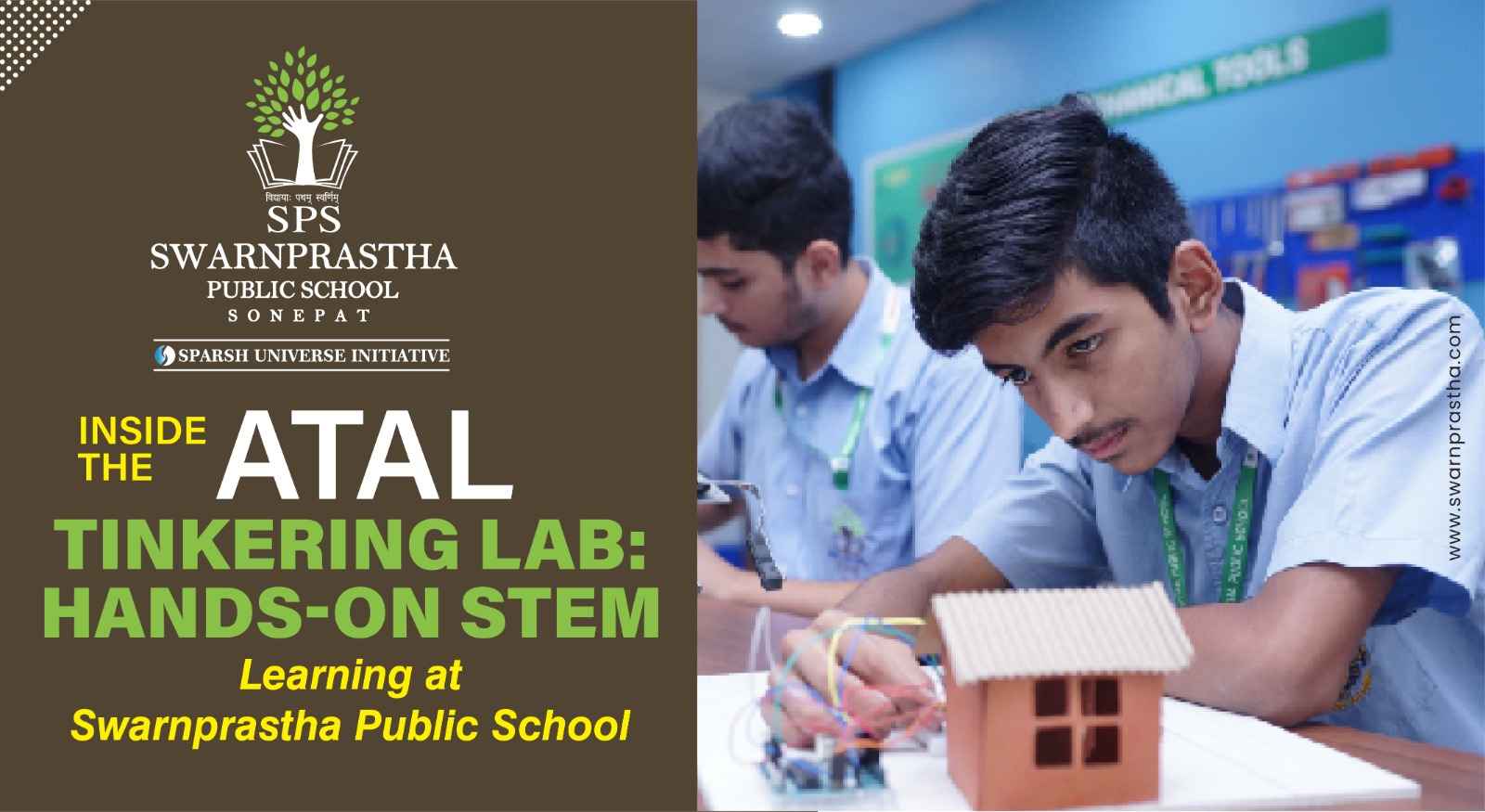
As soon as you walk in, you can feel a different energy in the air. The lights make the equipment shine, and the steady hum of 3D printers adds to the quiet focus of our students. We made sure that the shelves in the room are full of robotic kits and IoT sensors. This encourages kids to learn by doing instead of just watching. Our curriculum goes far beyond the basics. It includes Artificial Intelligence and adaptive technologies that even our most advanced Class 12 students find challenging at times.
Even though the level of sophistication is high, we have very strict safety rules and expert mentors who watch over every experiment to make sure that no unnecessary risks are taken. When parents see the structured space we've made for safe, but limitless, exploration, they worry a lot less.
Activities in the Lab and Real Life
Projects are what make the lab run. You might see robots navigating obstacle courses or sensors tracking local pollution levels to get real-world data on any given day. We break our tasks into streams that are manageable, but still difficult to make sure that our skills keep improving:
- Robotics: Where kids learn how to code and make their first robots.
- IoT, or the Internet of Things, is the process of connecting different devices to make smart, responsive networks.
- Microcontrollers: Learning about the "brains" that make the circuits work that power modern life.
We often think back to a team that spent weeks working on a flood alert system, making small changes to the sensors until the device was completely accurate. During these times of trial and error, thinking really sharpens. Ideas bounce around between teammates and failures teach the most important lessons.
Benefits for Future Leaders
STEM fluency opens up career paths in engineering and AI that were once thought to be impossible. The benefits of this kind of environment go far beyond the lab walls. We have seen that as people become more confident with technology, they start to come up with new ideas instead of doing the same old tasks over and over. This creativity often spills over into other subjects.
When students can see how a theory they talked about in class can be used in real life, Science starts to make more sense. Parents often say that their children's growth seems more "well-rounded," especially after they have to defend their ideas in front of a panel of experts at regional ATL events.
Real Stories from SPS Students
Take Aryan from Class 9. He built a solar-powered charger in the lab. It now powers his phone during outings. His parents beamed at the showcase. Similarly, a Class 7 team crafted an automated plant-watering system. They used sensors and coding. These successes motivate others. We host regular exhibitions for parents to see progress. Feedback from families warms us. One mother shared how her daughter now dreams of robotics engineering. Stories like these humanise the lab's impact.
Conclusion
Inclusivity is a principle we hold dear, so every child participates regardless of whether they have a natural knack for gadgets or have never touched a circuit board in their life. We track every bit of progress through detailed portfolios, and you'll receive regular updates via our JupSoft system so you can see exactly how they are developing. Should any doubts arise, we address them promptly to ensure no student is left behind. Furthermore, the lab integrates seamlessly with our D.I.C.E incubation centre, which allows those particularly inspired students to take their deeper projects even further into the realm of real-world entrepreneurship.
Frequently Asked Questions
Q1. Which classes access the Atal Tinkering Lab?
Ans: Students from Classes 6 to 12 form the core group that accesses the Atal Tinkering Lab on a regular basis. We tailor activities to suit their varying skill levels and interests. Younger children in lower classes can join select introductory sessions when ready. This ensures everyone benefits from STEM exposure over time.
Q2. What equipment fills the space?
Ans: The lab boasts of 3D printers for rapid prototyping alongside robotics kits perfect for assembly and coding. IoT sensors enable smart device projects while electronics packs support circuit building. All gear stays updated for cutting-edge hands-on learning.
Q3. What is the Atal Tinkering Lab at Swarnprastha Public School?
Ans: The Atal Tinkering Lab (ATL) is an innovation and STEM learning space established under the NITI Aayog initiative. It enables students to explore robotics, artificial intelligence (AI), IoT, coding, electronics, and design thinking through hands-on projects and real-world problem-solving.
