


For many years, Indian education placed heavy emphasis on rote learning. Students were needed to memorise facts for exams. That got them good marks, but it pretty much left them without any real grasp of the subject or skills they could actually use. The question here is - is just cramming facts enough to get children ready for life and career after school?
Dynamics in the real world are changing at a fast pace. Careers that span the globe call for creativity and being able to adapt and the ability to figure out problems and come with solutions. Employers need people who can think for themselves and team up effectively with others.This is where experiential learning has begun to transform education, especially in boarding schools.
By moving beyond rote learning, the best boarding schools in Sonipat are offering students opportunities to learn by doing, reflecting, and applying.This change is shaping confident, capable young adults who are ready to face a complex and competitive world.
What is Rote Learning?
Rote learning is memorisation without full understanding. Children might be able to remember formula or definitions or even timelines without much trouble. But when it comes to actually using these in real life, they often hit a wall. A child who memorises a science term just fine may really draw a blank in a basic experiment on how to apply it.
Rote learning has its place for basics. But leaning on it too hard brings problems. It kills off curiosity and exams turn into a big stress fest for no good reason. Understanding is often missing.
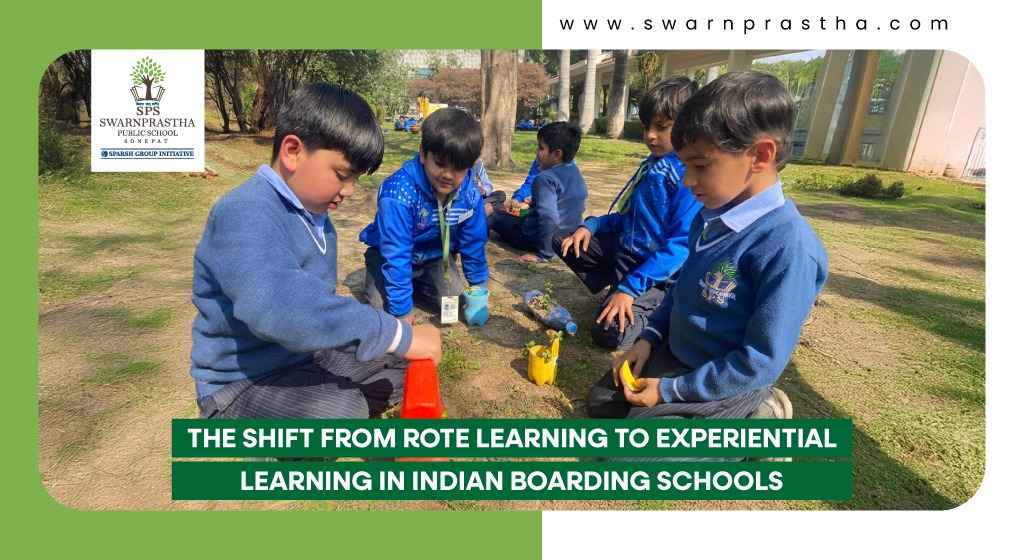
Experiential learning flips this around. It gets children involved for real, through hands-on projects or talks and involves them in analysing the results as well as the process. Theory meets with what they do every day, so learning sticks and becomes meaningful.
Experiences like running experiments in the lab, or debates and role plays empower children to discuss with peers. Community service helps them grasp responsibility, empathy too. And getting involved in arts, theatre and sports builds creativity and lends that invaluable learning of collaboration in a team.
Children hold onto what they learn way longer this way. And they pick up skills for life that matter.
Boarding schools set this up just right. Everyone lives right there on campus, so school mixes with everyday living in a full-on way. Teachers keep the learning going past class time, pulling in sports or arts, community events to help children grow. This 24-hour environment allows children to practise independence, leadership and problem-solving every day. It is not limited to scheduled classes, but continues through dorm life, shared responsibilities and co-curricular programmes.
Benefits of Experiential Learning
Parents often ask what makes experiential learning more effective than memorisation. The advantages are clear:
- Stronger understanding: Students grasp concepts at a deeper level.
- Practical application: Learning becomes useful in real-life situations and challenges.
- Confidence building happens through presentations, projects and teamwork. You know, Communication and leadership skills happen through everyday engagement in team actives.
- Then there's adaptability. Students figure out how to tackle challenges, roll with changes as they come and work in diverse teams.
- Emotional growth comes from joining in community and cultural activities. That kind of participation builds empathy and helps with maturity in a real way.
This whole approach makes sure children get ready not just for exams. They prepare for careers and even personal growth along the way.
Swarnprastha Public School and Experiential Learning
Swarnprastha Public School weaves experiential learning right into the academic setup and everyday routines. Classrooms turn interactive fast. Teachers push for questions and discussions. Students participate actively in workshops, field visits and projects that connect what they learn in class to actual real-world happenings.
Beyond just the books and tests, SPS puts a lot into co-curricular activities. These shape well-rounded personalities, from the ground up through theatre, sports, service initiatives. Every bit of these aims to build character and confidence in children. They come home more expressive, way more curious and eager to spill what they've picked up that day.
Preparing for the Future
Shifting from rote learning to experiential isn't some passing trend in education. It's what the future actually calls for. Careers in India or abroad need critical thinkers, problem-solvers and compassionate leaders. Students who go through this learning style end up better set for higher studies. Professional chances open up more easily for them.
For parents, that brings some real peace of mind. Experiential learning means their children stay strong in academics. But they also pick up life skills to make it in the real world.
Conclusion
Education these days isn't about cramming and memorising everything a child can hold. It's more about applying what they know, adapting on the go and growing through it all. Boarding schools lead the way here. They offer experiential learning that mixes knowledge with actual skills. Swarnprastha Public School sets up an environment for students to explore, to question things, to learn hands-on through experiences that gear them up for life ahead. Parents picking Swarnprastha give their children a gift of education. This goes way beyond marks. It builds readiness for tomorrow's world.
FAQs
FAQ 1: Does experiential learning reduce focus on academic performance?
No. Experiential learning strengthens academics by helping students understand concepts better and retain them for longer. It complements exams rather than replacing them.
FAQ 2: How does experiential learning help in a child’s future career?
It builds problem-solving, creativity and teamwork. These are qualities employers look for across industries, making experiential learning vital for global career readiness.
