


Most parents spend months researching schools before making a final decision. They visit campuses, read reviews, speak to other families. And still, doubt lingers. That is not unusual. Schools make a lot of promises. The question is always — which ones keep them?
Swarnprastha Public School is located in Sector 19, Sonepat, on an 18-acre green campus. It offers CBSE education from Nursery through to Class XII, with day schooling and boarding available. Over the years, a significant number of families from Sonipat and across the Delhi NCR region have chosen this school — and kept their children here. That kind of sustained trust does not come from marketing. It comes from experience.
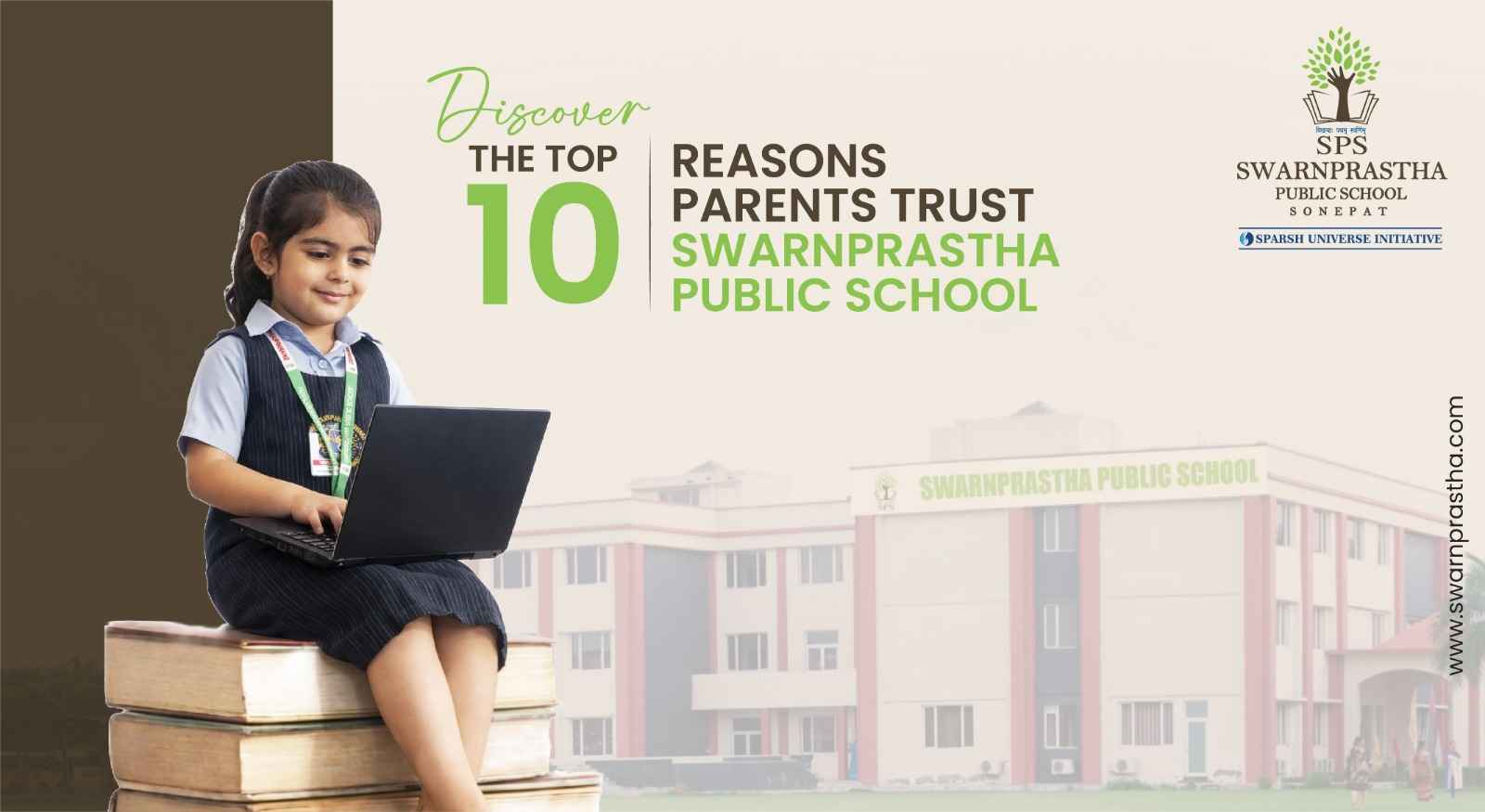
Here are ten reasons why parents continue to place their confidence in SPS.
1. The Board Results Are Consistent
In the CBSE 2025 Board Examinations, SPS students delivered results worth noting. Dyuti Tyagi and Divyanshi Rathee topped Class XII Humanities with 96.6%. Tejas Dhawan led Commerce with 95.2%. In Science, Prachi Kanyal scored 91.8%. Several Class X students secured full marks in Mathematics, Social Science and Science.
What matters is not just a single good year. These numbers follow a pattern that parents who have been with the school for several years will recognise. Preparation here is thorough, and it shows.
2. Teaching That Goes Beyond the Textbook
SPS follows CBSE — but how a school teaches matters as much as what it teaches. The school’s learning philosophy draws on Project-Based Learning (PBL) and on the understanding that children carry eight different types of intelligence. Not every child learns the same way, and the curriculum at SPS is designed with that in mind.
Every classroom is air-conditioned and fitted with an Interactive Board. Lessons are structured to encourage participation rather than passive note-taking. Children are expected to think, question and apply — not simply memorise.
3. Teachers Who Know Their Students
A school can have excellent facilities and still fail a child if the teachers are not paying attention. At SPS, the faculty are experienced and, by most accounts, genuinely engaged with their students. No child’s particular strengths go unnoticed for long.
Remedial classes are available for students who fall behind. Counselling sessions are part of the school calendar, not an afterthought. Career guidance starts early enough to actually be useful. These are not add-ons — they are how the school functions ordinarily.
4. Sport and the Arts Are Taken Seriously
At SPS, co-curricular activities are not treated as fillers between academic periods. They are considered part of how a child develops. The school offers a substantial range of options:
• Sports: Football, Tennis, Basketball, Cricket, Badminton, Swimming, Squash, Taekwondo and Shooting
• Visual and Performing Arts, including Music
• Yoga, Pranayama and Meditation
• Community service and social responsibility programmes
Children who find their strengths outside the classroom often do better inside it too. SPS understands that connection.
5. A Campus Worth Seeing in Person
The campus covers 18 acres in Sonepat. That is not a number to gloss over — it translates into proper playfields, courts for Basketball and Tennis, a swimming facility and classroom blocks that do not feel cramped. The Atal Tinkering Lab gives students space to experiment with science and design. The D.I.C.E. (Design, Innovation, Creativity and Entrepreneurship) initiative runs alongside regular academics, exposing children to real-world problem-solving.
The campus is well maintained and green. For children who spend long hours at school, that environment matters more than most people initially realise.
6. The Duke of Edinburgh’s Award — Available Here
Few schools in this region offer the Duke of Edinburgh’s International Award. SPS does. This is a globally recognised programme that challenges students across four areas: volunteering, physical activity, skill development and an expedition.
For students applying to universities abroad or to competitive domestic institutions, this award carries real weight. It signals initiative, follow-through and a willingness to be tested outside the comfort of a classroom. Parents who have their eye on their child’s future beyond school will understand why this matters.
7. Boarding Options Designed Around Real Families
SPS offers three boarding arrangements. Full Boarding is for students who live on campus throughout the term. Day Boarding gives children extended school hours — supervised study, sports and meals — before returning home each evening. Flexi Boarding is a more recent option, designed for families whose schedules do not fit neatly into the traditional residential model.
All three carry the same standard of academic instruction and pastoral care. We recognise that no two families are identical, and the boarding structure at SPS reflects that.
8. Safety Is Built In, Not Bolted On
CCTV cameras are installed in every classroom and across the campus. Boarding areas are monitored separately. This is the visible layer of safety. But at SPS, the less visible layer matters just as much.
Counsellors are accessible to all students, not just those in crisis. Boarding students are known by name, checked in on regularly and supported through the adjustment that residential life requires. Parents of boarders frequently tell us that their children settled far sooner than they expected. A school that takes emotional safety as seriously as physical security earns that outcome.
9. A School With a Sense of Its Own History
SPS takes its name from Swarnprastha — the ancient city referenced in the Mahabharata, identified with present-day Sonipat. The school carries that heritage seriously. Its mission is to bring together the values of the Gurukul tradition — discipline, integrity, respect for learning — and the demands of modern education.
In practice, this means that moral education, empathy and social responsibility are woven into daily school life. Not as separate lessons, but as the way the school conducts itself. Students who leave SPS tend to carry those values with them. The alumni community, which remains active and engaged, is perhaps the clearest evidence of this.
10. Leadership With Experience and a Clear Direction
Schools that perform consistently tend to have leadership that stays the course. SPS is guided by Chairman Mr. Roshan Agarwal. CEO Dr. Amit Saxena and Principal Mr. Rohit Panda — who brings 26 years of experience in education — manage the school’s day-to-day direction.
Under this leadership, SPS has been ranked among the top CBSE schools in Sonipat by Careers 360 magazine. Admissions for the Academic Session 2026–27 are currently open. For families beginning their search now, this is worth noting.
In Conclusion
There is no single reason why families choose Swarnprastha Public School, Sonepat. For some, it is the board results. For others, it is the boarding flexibility or the campus. For many, it is simply that the school has a track record — one that other parents they know can vouch for.
If you are currently weighing your options, we would encourage you to visit. Walk the campus, ask the questions that matter to you and speak to the teachers directly. The picture that emerges tends to be a convincing one.
Frequently Asked Questions
Q1. What boarding options does SPS offer, and which is suitable for my child?
SPS offers three boarding arrangements: Full Boarding, where students reside on campus throughout the term; Day Boarding, where students attend extended school hours but sleep at home; and Flexi Boarding, a flexible residential option suited to families with varied schedules. Each option provides the same quality of education and pastoral care. The right choice depends on your child’s age, temperament and your family’s circumstances. The admissions team at SPS is available to guide you through the decision.
Q2. How does SPS ensure the safety and wellbeing of students on campus?
SPS takes student safety seriously. CCTV cameras are installed in every classroom and across the wider campus. The school has a trained counselling team that supports students across all year groups. For boarding students, a structured and caring residential environment ensures that they feel secure and well looked after. The school also maintains strong communication with parents, keeping families informed about their child’s progress, health and wellbeing throughout the academic year.
